
Have you ever opened your jewellery box, picked up a pair of earrings you loved and thought:
“Wait… why has this turned black already?”
Maybe you bought it only a few weeks ago.
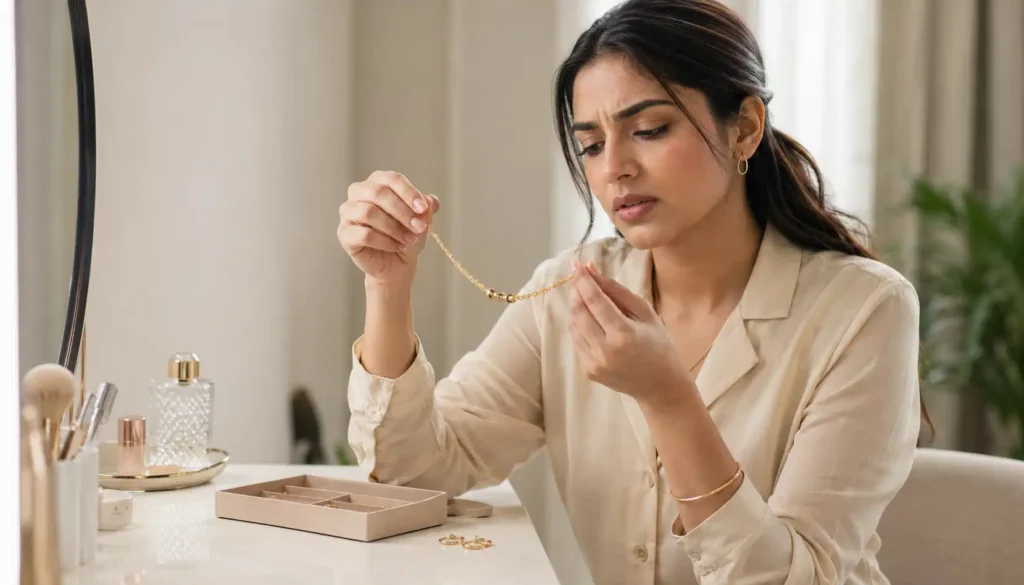
Maybe you wore it to work three or four times.
Maybe it looked bright and beautiful when you first bought it, but now the chain looks dull, the ring has dark spots or the back of your earrings has changed colour.
And naturally, you start wondering:
Why does my artificial jewellery turn black so fast?
The short answer is simple.
Artificial jewellery can turn black when the metal or its outer coating reacts with things around it, such as air, moisture, sweat, perfume, skincare products and chemicals.
This change is commonly called tarnishing.
Metal tarnishing is a real chemical process. Humidity can make some metals tarnish faster, while sulphur-containing substances can darken metals such as silver and copper. Oils and salts from our skin can also affect polished metal surfaces.
But here is the good news.
A little knowledge can make a big difference.
Once you know why artificial jewellery turns black, you can change a few small habits and help your favourite pieces stay beautiful for much longer.
So, before you throw away that necklace or blame yourself for “spoiling” your jewellery, let us understand what is really happening.
“Jewellery that fits into your everyday life should not need complicated everyday care.”
What Does It Mean When Artificial Jewellery Turns Black?
When jewellery becomes dark, black, brown, greenish or dull, we often say it has tarnished.
Tarnish is a thin layer that forms on the surface of some metals after they react with substances in their surroundings.
Think of it this way.
Your jewellery is touching the world all day.
It touches your skin.
It meets your sweat.
It sits near perfume.
It may get splashed with water.
It stays inside drawers and boxes.
It faces hot summers, humid monsoons, pollution and long days outside.
Over time, all these little things can affect its surface.
Some metals naturally react more easily than others. Copper, for example, can gradually darken when exposed to certain substances in the air. Silver can form a dark sulphide layer, which may eventually look black.
Artificial jewellery may also have several layers.
There may be a base metal underneath and a gold-coloured, silver-coloured or protective coating on top.
When that top coating becomes weak, thin or damaged, the metal below may become more exposed.
That is when colour changes can become easier to see.
So artificial jewellery turning black does not always mean that your jewellery was dirty.
It can be the result of chemistry, environment, materials, coating quality and the way the jewellery is worn and stored.
Why Does Artificial Jewellery Turn Black?
There is usually not one single reason.
Most of the time, several small things are working together.
Here are nine of the most common causes.
1. Sweat Can Make Jewellery Tarnish Faster
India can get hot.
Very hot.
You step out for work.
You walk to the metro or bus.
You spend time outdoors.
You rush between meetings.
You attend college all day.
Naturally, you sweat.
Your jewellery is often sitting directly against that skin for hours.
Sweat contains moisture and salts. Highly polished metals such as silver and copper can be sensitive to salts and oils from our skin.
That does not mean you should stop wearing jewellery in summer.
It simply means your jewellery needs a small amount of care after a long day.
For example, when you remove your necklace after work, do not immediately drop it into a closed box if it feels damp.
First, gently wipe it with a clean, soft and dry cloth.
Allow it to become fully dry.
Then store it.
One small habit can prevent sweat and moisture from sitting on the surface all night.
Simple rule:
Sweat happens. Leaving sweat on your jewellery does not have to.
2. Humidity and Monsoon Weather Can Speed Up Tarnishing
Have you noticed that some things feel harder to keep dry during the monsoon?
Your jewellery feels the same weather.
Humidity means there is more moisture in the air.
And moisture can make corrosion and tarnishing happen faster for many metals. Research from the Canadian Conservation Institute, for example, notes that higher relative humidity can increase silver’s tarnishing rate.
This matters in many parts of India, especially during humid weather.
Your jewellery does not need to be dropped into water to meet moisture.
Moisture can already be present in the air.
That is why storing jewellery properly becomes extra important during humid months.
Instead of leaving everything together in an open tray, keep pieces dry and separated.
A dry jewellery box or pouch can help.
You can also use a suitable moisture-absorbing packet inside the storage area, provided it cannot spill or come directly into contact with the jewellery.
Dry storage is one of the simplest ways to slow down unwanted changes.
3. Perfume Can Be a Problem
Picture your morning.
Moisturiser.
Makeup.
Perfume.
Earrings.
Necklace.
Watch.
Bag.
And you are out of the door.
But sometimes the order is different.
You wear your necklace first.
Then you spray perfume around your neck.
The perfume lands directly on your jewellery.
That is a habit worth changing.
Fragrances and cosmetics are among the products commonly recommended to keep away from jewellery surfaces because repeated chemical exposure can affect metals.
Instead, try this rule:
Perfume first. Jewellery later.
Apply your perfume.
Give it time to dry.
Then put on your jewellery.
Your jewellery can still complete the look without receiving the perfume itself.
This is sometimes called the “last on” rule.
Your jewellery should be one of the last things you put on before leaving home.
4. Lotion, Sunscreen and Skincare Can Build Up on Jewellery
Your skincare is doing an important job.
But it does not need to do that job on your earrings.
Creams, sunscreen, body lotion, makeup and hair products can collect on jewellery.
Over time, this can leave the surface looking dull and may increase exposure to substances the jewellery was not designed to sit in all day.
This is especially common with:
rings,
bracelets,
necklaces,
and earrings near the face and hair.
Apply your skincare first.
Let your skin absorb it.
Then wear your jewellery.
The idea is very simple:
Let skincare stay on your skin and jewellery stay on your look.
5. Water Exposure Can Affect Artificial Jewellery
“Can I wear artificial jewellery in water?”
The safest answer is:
Check the care instructions for that exact piece.
Artificial jewellery is not one single material.
Different products may use different metals, plating methods and protective coatings.
Some jewellery may be made to handle more everyday moisture than basic fashion jewellery.
Other pieces should be kept away from water as much as possible.
Unless the seller specifically says that your jewellery is suitable for a certain type of water exposure, avoid treating every piece as waterproof.
Be especially careful around:
showers,
swimming pools,
the sea,
cleaning water,
and household chemicals.
Chlorine, bleach and other strong chemicals are known to damage or speed discolouration in jewellery metals.
If your jewellery accidentally becomes wet, do not panic.
Gently dry it.
Do not leave it wet inside a box.
And do not store it until it feels fully dry.
6. The Outer Plating Can Slowly Wear Down
Many artificial jewellery pieces get their colour from an outer layer or plating.
Imagine painting a beautiful finish over another material.
As long as the outer layer stays in good condition, you see that finish.
But jewellery goes through a lot.
It rubs against your skin.
A bracelet touches your desk.
A necklace moves against your clothes.
Rings touch bags, keyboards, phones and handles.
Earrings touch hair and skincare.
Little by little, friction can affect the surface.
The speed of that change depends on many things, including the materials, coating, thickness, finish, frequency of wear and your habits.
This is why two pieces of jewellery may not age in exactly the same way.
Even if you bought them on the same day.
7. Your Jewellery May Be Rubbing Against Other Jewellery
Do you keep ten necklaces together in one pouch?
That may save space.
But it can be hard on the jewellery.
Chains can rub against chains.
Earrings can scratch pendants.
Rings can hit bracelets.
Stones can catch on other pieces.
Repeated rubbing can damage delicate surfaces and coatings.
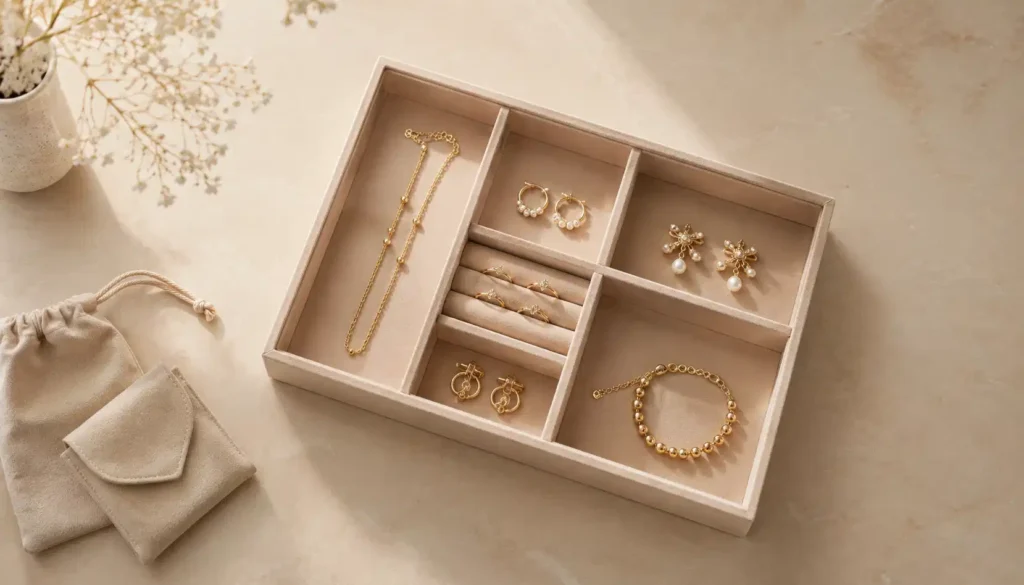
Instead, store pieces separately whenever you can.
You do not necessarily need a huge jewellery cabinet.
Small individual pouches or separate sections in a jewellery organiser can work well.
The goal is simple:
Less rubbing. Less scratching. Less unnecessary surface damage.
8. Poor Storage Can Make Tarnishing Worse
Where does your jewellery sleep at night?
It matters more than you may think.
Leaving jewellery in a bathroom is usually not a great idea because bathrooms often become humid.
Leaving pieces uncovered near windows can expose them to dust, moisture and changing conditions.
And throwing everything together in one drawer creates rubbing and scratches.
Good storage should be:
clean,
dry,
and separated.
For metals that are sensitive to tarnishing, conservation guidance also recommends controlling moisture and using dry storage conditions.
After wearing a piece:
wipe it,
make sure it is dry,
and place it back in its own space.
Your jewellery box should feel less like a messy handbag and more like a tiny wardrobe.
Every piece gets its own place.
9. Material and Coating Quality Matter Too
Care matters.
But care is not the whole story.
The materials used to make the jewellery matter too.
The base metal matters.
The plating matters.
The surface treatment matters.
The protective coating matters.
The manufacturing process matters.
That is why a ₹100 piece and a better-made anti-tarnish piece may behave differently even if both look gold-coloured on day one.
You cannot “care” a badly made product into becoming a premium one.
And even a good product will last better when you care for it properly.
Think of it as a partnership:
Good jewellery + good care = a better everyday experience.
Does Artificial Jewellery Turning Black Mean It Is Bad Quality?
Not always.
This is important.
Almost every jewellery material has its own care needs.
Even sterling silver can tarnish. Silver can darken when it reacts with sulphur-containing substances, while humidity, perspiration and cosmetics can also affect it.
So colour change alone does not tell you the full story.
The better questions are:
How quickly did it happen?
How was the jewellery being used?
Was the product sold as everyday jewellery?
Was it advertised as anti-tarnish?
Was it exposed to perfume, chlorine or heavy moisture?
How was it stored?
Did the seller give clear material and care information?
A jewellery brand should be clear about what the customer is buying.
And as a customer, you should know what kind of care your jewellery needs.
What Is Anti-Tarnish Jewellery?
You may now be thinking:
“If regular artificial jewellery can tarnish, what exactly does anti-tarnish mean?”
Anti-tarnish jewellery is designed to resist tarnishing better than jewellery without that protection.
The important word here is resist.
Anti-tarnish should not be understood as a magical promise that no material can ever change under any condition.
Water.
Chemicals.
Sweat.
Friction.
Storage.
How often you wear the piece.
All of these can affect the life of jewellery.
But better materials, plating processes and protective finishes can help slow down unwanted colour changes.
That is why anti-tarnish jewellery has become attractive for women who want jewellery for real everyday life.
Not only weddings.
Not only parties.
Not only special occasions.
But Monday meetings.
Tuesday coffee.
Wednesday college.
Thursday dinner.
Friday office plans.
And everything in between.
“The best everyday jewellery is the jewellery you do not have to save for a special day.”
This idea is especially important for modern daily-wear jewellery.
A woman should be able to put on a simple pair of earrings or a delicate necklace in the morning and feel polished throughout her day.

That is the thinking behind Purnave Jewelz’s everyday 9-to-9 jewellery idea: simple, modern pieces made for office-to-evening style without making jewellery feel like something you can enjoy only on occasions.
Can Anti-Tarnish Jewellery Still Turn Black?
It can still change over time depending on the material, coating, wear and care.
“Anti-tarnish” is better understood as resistance to tarnishing, not permission to expose jewellery to every possible chemical forever.
Think about a water-resistant watch.
Water resistance does not automatically mean you should treat every watch like diving equipment.
In the same way, read the specific product care instructions for your jewellery.
If a brand says a piece is water-resistant, check what that means for that specific product.
If a brand says to avoid perfume or swimming, follow those instructions.
Good care and anti-tarnish design work best together.
How to Prevent Artificial Jewellery From Turning Black
Now we come to the part most people really want.
What can you actually do?
Fortunately, your jewellery routine does not need to become complicated.
Follow the “Last On, First Off” Rule
Put your jewellery on after:
perfume,
makeup,
sunscreen,
lotion,
and hair products.
When you come home, remove your jewellery before showering, changing clothes or starting housework.
In simple words:
Last thing on. First thing off.
Wipe Jewellery After Wearing It
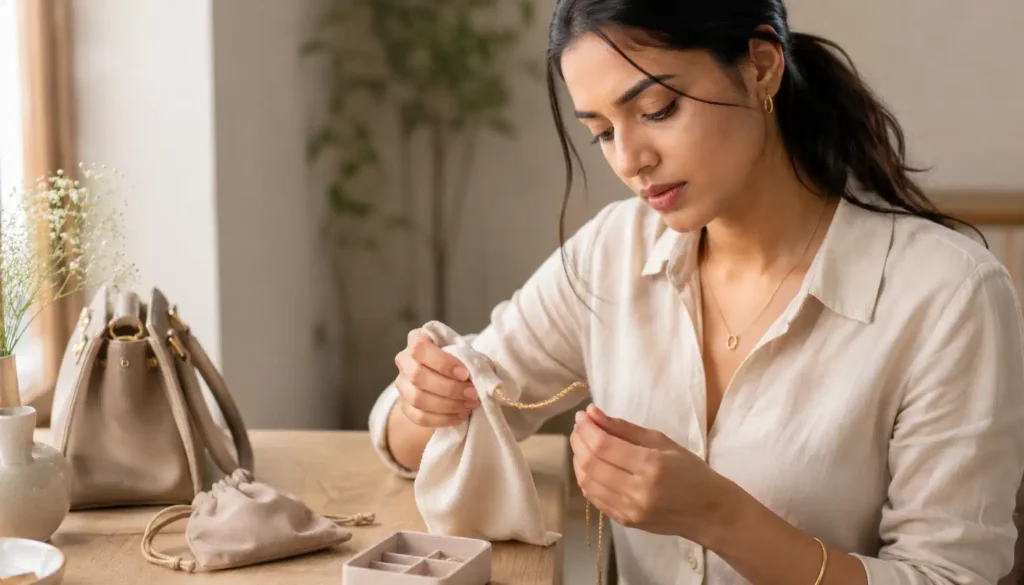
You do not need a thirty-minute cleaning routine every night.
A gentle wipe can already help.
Use a clean, soft, dry, lint-free cloth.
Pay extra attention to parts touching your skin.
For example:
the inside of a ring,
the back of earrings,
the clasp of a necklace,
and the inside of a bracelet.
The goal is to remove sweat, oil and surface moisture before storage.
Keep It Dry Before Storing
Never put damp jewellery straight into a closed pouch.
Let it dry fully first.
This becomes even more important during humid weather.
Store Pieces Separately
Give each piece a little breathing room.
Keep delicate jewellery in separate pouches or compartments.
This reduces rubbing, tangling and scratching.
Avoid Direct Perfume
Spray your perfume before wearing jewellery.
Wait for it to dry.
Then add the jewellery.
This tiny change takes almost no effort.
Take It Off Before Swimming or Cleaning
Swimming pools may contain chlorine.
Household cleaners can contain strong chemicals.
These are not environments where you want your everyday jewellery spending time unless the manufacturer specifically says otherwise.
Follow the Brand’s Care Instructions
This one may sound obvious.
But it is important because different jewellery is made differently.
A care method that works for solid silver may not be right for plated artificial jewellery.
A cleaning product that works on one gemstone may damage another.
Always treat the product instructions as your first guide.
How to Clean Artificial Jewellery Safely at Home
The internet is full of “jewellery hacks.”
Toothpaste.
Baking soda.
Vinegar.
Lemon juice.
Random cleaning powders.
The problem is that artificial jewellery is not one material.
A DIY method may clean one metal while damaging the plating, adhesive, stone, pearl or finish on another.
Toothpaste and other abrasive cleaners, for example, can scratch or erode jewellery surfaces. GIA specifically advises against abrasive materials such as toothpaste for jewellery cleaning.
So do not start with the strongest cleaner you can find.
Start with the gentlest method.
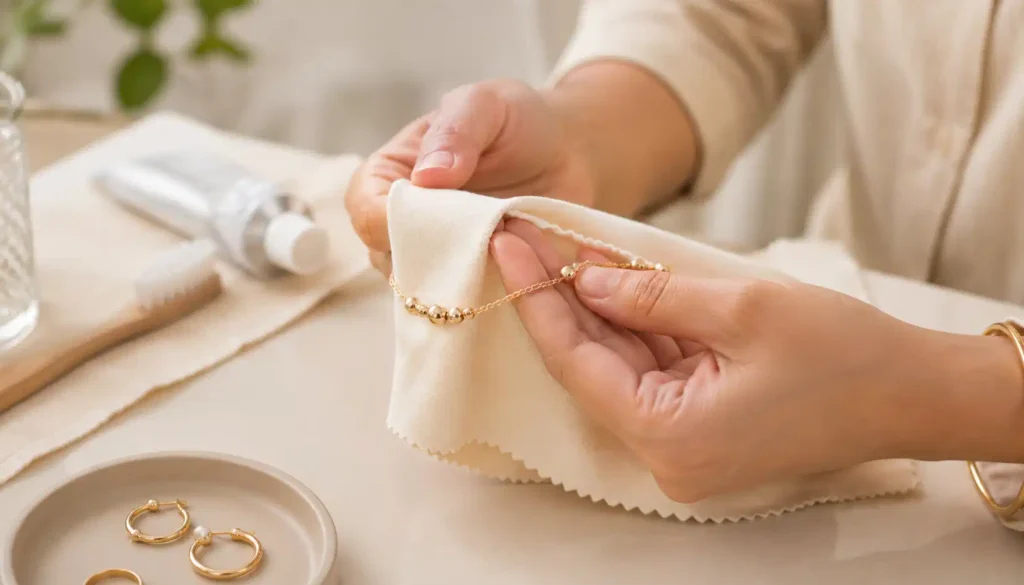
For most everyday artificial jewellery, if the brand’s care instructions allow it, begin with a soft dry cloth.
Do not scrub hard.
Do not use a rough kitchen cloth.
Do not use a toothbrush unless the manufacturer says it is suitable for that piece.
Do not soak jewellery simply because a social-media video tells you to.
And never assume that “natural” ingredients are automatically safe for metal plating.
When you are unsure, ask the seller how the piece should be cleaned.
That is much safer than experimenting on your favourite necklace.
Can You Fix Artificial Jewellery That Has Already Turned Black?
Sometimes.
But it depends on why the colour changed.
If the jewellery is simply dull because of surface dirt, oil or residue, gentle cleaning may improve its appearance.
If the jewellery has actual tarnish, a suitable cleaning method may help in some cases.
But if the outer plating has worn away, cleaning cannot magically put that coating back.
The piece may need professional replating or refinishing.
That distinction matters.
Cleaning removes something from the surface.
Replating adds a new surface layer.
They are not the same job.
So if your favourite artificial jewellery has become badly discoloured, do not keep rubbing it harder and harder.
More rubbing may make the remaining coating worse.
Instead, check whether professional refinishing is possible or whether it makes more sense to replace the piece.
7 Habits That Can Make Your Artificial Jewellery Last Longer
If you remember nothing else from this article, remember these seven habits:
- Put perfume and skincare on before jewellery.
- Wipe sweat from jewellery after wearing it.
- Let jewellery dry fully before storing it.
- Keep pieces in separate pouches or compartments.
- Avoid strong household chemicals.
- Do not use random DIY cleaning hacks.
- Follow the care instructions for your exact jewellery.
None of these habits is difficult.
That is the point.
You should not need a science degree to care for daily-wear jewellery.
Why Everyday Jewellery Needs to Match Everyday Life
For many Indian women, jewellery is changing.
It is no longer only about a heavy set kept safely for weddings.
There is another kind of jewellery wardrobe now.

A tiny hoop for Monday.
A delicate chain for the office.
A bracelet with a white shirt.
A simple pendant with a kurta.
Small earrings for college.
A stackable ring for dinner after work.
Jewellery is becoming part of the everyday outfit.
And when the way we wear jewellery changes, what we expect from jewellery changes too.
You want something beautiful.
But you also want something easy.
Something modern.
Something that does not make an office outfit feel too heavy.
Something you can style again tomorrow with something completely different.
That is where daily-wear and anti-tarnish jewellery make sense.
The goal is not to compete with a bridal jewellery box.
The goal is to solve a different problem.
“What can I wear today that makes me feel a little more put together?”
Sometimes the answer is not a huge necklace.
Sometimes it is one tiny pair of earrings.
And that is enough.
How to Choose Better Artificial Jewellery for Daily Wear
Before buying your next piece, look beyond the photo.
Ask what it is made from.
Check whether the seller explains the plating or finish.
Read the care instructions.
Look for clear information about whether it is intended for occasional wear or daily wear.
Understand what terms like “anti-tarnish,” “water-resistant” or “skin-friendly” mean for that exact product instead of assuming every brand uses them in exactly the same way.
And choose designs you will actually wear.
That last point matters.
The best value jewellery is not always the cheapest piece.
It is the piece you reach for again and again.
A ₹299 pair of earrings worn fifty times can feel far more valuable than a ₹1,500 pair that stays untouched in a drawer.
Everyday jewellery should earn its place in your wardrobe.
Key Takeaways
- Artificial jewellery usually turns black because its metal or surface coating reacts with moisture, sweat, air, chemicals or other substances.
- Humidity can increase the speed of tarnishing for some metals.
- Perfume, skincare, perspiration and strong chemicals can affect jewellery surfaces.
- Poor storage, rubbing and repeated wear can damage delicate finishes.
- Put jewellery on after perfume, makeup and skincare.
- Wipe jewellery with a clean, dry, soft cloth after wearing it.
- Keep jewellery dry and store pieces separately.
- Avoid random DIY cleaning methods such as toothpaste because abrasive products can damage jewellery.
- Anti-tarnish jewellery is meant to resist tarnishing better, but it should still be cared for properly.
- Better materials and better care work together to help everyday jewellery stay beautiful for longer.
Frequently Asked Questions About Artificial Jewellery Turning Black
1. Why does my artificial jewellery turn black after only a few wears?
It may be reacting with sweat, moisture, perfume, skincare, chemicals or the air around it. Repeated friction may also weaken the outer finish. If it happens very quickly even with careful use, the quality or thickness of the surface coating may also be a factor.
2. How can I stop artificial jewellery from turning black?
Keep it away from unnecessary moisture and strong chemicals. Apply perfume, lotion and skincare before wearing jewellery. Wipe your jewellery dry after use and store each piece separately in a clean, dry place.
3. Does sweat make artificial jewellery black?
Sweat can contribute to jewellery tarnishing because it brings moisture and salts into contact with the metal. Skin oils and salts can affect polished metals, which is why wiping jewellery after a hot or long day can be helpful.
4. Can perfume turn artificial jewellery black?
Repeated direct exposure to fragrance and cosmetics can affect jewellery surfaces. A safer habit is to spray perfume first, allow it to dry and then wear your jewellery.
5. Can I shower while wearing artificial jewellery?
Only if the care instructions for that specific product say it is suitable for that type of exposure. Artificial jewellery can use many different materials and coatings, so it is better not to assume every piece is waterproof.
6. Does anti-tarnish jewellery never turn black?
Anti-tarnish jewellery is designed to resist tarnishing better, but no jewellery should automatically be treated as unaffected by every chemical, environment or kind of wear. Follow the care instructions for the exact product.
7. What is the best way to store artificial jewellery?
Store it clean and completely dry. Keep different pieces separate when possible so they do not rub and scratch one another. Avoid very humid storage areas.
8. Can I use toothpaste to clean artificial jewellery?
It is better not to. Toothpaste can contain abrasive material that may scratch or wear jewellery surfaces. GIA also advises avoiding abrasive products such as toothpaste when cleaning jewellery.
9. Can tarnished artificial jewellery become shiny again?
Sometimes. If the problem is dirt or surface residue, gentle cleaning may help. If the plating itself has worn away, the piece may require professional replating or refinishing rather than simple cleaning.
10. Why does jewellery turn black faster during humid weather?
Moisture can help corrosion and tarnishing reactions happen more easily. Higher humidity has been shown to increase the tarnishing rate of metals such as silver.
Final Thoughts: Your Jewellery Should Work With Your Day

Your favourite artificial jewellery turning black can be disappointing.
But once you understand why it happens, jewellery care becomes much simpler.
You do not need ten products.
You do not need complicated cleaning tricks.
And you certainly do not need to keep your favourite jewellery locked away because you are scared to wear it.
Start with the basics.
Perfume first.
Jewellery last.
Wipe after wearing.
Keep it dry.
Store it properly.
Choose jewellery made for the kind of life you actually live.
Because everyday jewellery should feel exactly like that:
everyday.
At Purnave Jewelz, that is the idea behind Your Everyday Signature—modern, easy-to-style jewellery for women who want a polished look that can move from morning plans to office hours and evening moments.
A piece of jewellery does not have to be loud to change how you feel.
Sometimes a small hoop, a delicate chain or a simple ring is enough to make the whole look feel complete.
“Your everyday style does not need more jewellery. It needs the right jewellery.”
And when you understand how to care for it, you can spend less time worrying about your jewellery turning black—and more time enjoying the way it makes you feel.